 Simpleswapcrypto
 combines liquidity sources for crypto exchanges that pay out to your wallet
Simpleswapcrypto aggregates crypto liquidity and routes exchanges from a deposit to the receiving wallet that you specify. Fixed swaps use a time-limited quote, while floating swaps calculate the payout when processing. Most crypto swaps do not require registration. Fiat purchases and supported crypto sales involve separate payment arrangements, with availability tied to providers and location. It does not provide a trading balance for storing cryptocurrency between swaps.
Selected assets, networks, and available directions
The sending asset, receiving asset, and their networks determine which exchange directions the service can offer at that moment. A currency listing does not establish that every conversion involving that currency is available. Pair availability, amount limits, and a usable quote answer separate questions. The service offers crypto-to-crypto conversion, fiat purchases, and supported crypto sales, so the starting funds also determine which kind of exchange applies.
A token ticker identifies the asset, while its network identifies the blockchain on which the transfer occurs. The receiving wallet must support both. Some destinations also need a MEMO or another extra identifier to credit the correct account. The API therefore identifies currencies using both ticker and network information. Before a deposit, matching a symbol alone does not establish compatibility with the selected destination.
Routing between centralized and decentralized liquidity
Aggregated liquidity lets the service arrange a conversion through multiple provider sources, including centralized exchanges and decentralized exchanges. Centralized exchanges are commonly abbreviated as CEXs; decentralized exchanges are DEXs. The aggregator handles provider routing for the requested exchange. Its main contribution is access to those sources through a shared exchange flow, without requiring the user to compare separate provider offers manually.
Crypto exchange processing begins with a deposit to the address supplied for the order. After the necessary blockchain confirmations, the provider network processes the conversion and sends the exchanged asset to the receiving address. The deposit address and recipient address serve different purposes. Aggregation describes the liquidity arrangement behind that conversion; it does not establish that every swap uses a particular DEX, bridge, or single blockchain transaction.
Wallet delivery and temporary processing
Wallet delivery removes the need for an exchange account that stores the proceeds after a completed crypto swap. The service does not need your private keys or recovery phrase. Processing still involves a deposit and external providers. Legal or regulatory requirements can lead to a hold on funds. Control of the destination wallet therefore does not mean that an exchange has no intermediary dependencies or that every deposit moves immediately to its recipient.
Fixed quotes and floating estimates
Rate mode determines how the receiving amount responds to market changes while the deposit moves through confirmation and exchange processing. The service can decline a fixed or floating order during major market movements or disruption. It may then return the funds, seek agreement on a new rate, or arrange another agreed resolution.
Fixed-rate deposit conditions
A fixed quote locks the exchange rate for 20 minutes. The deposit must arrive and gain at least one blockchain confirmation within that window. Sending before the deadline alone does not satisfy the confirmation condition. A late deposit can proceed at the original rate if that rate remains unchanged. If the rate has changed, the exchange may fail and require a refund decision or acceptance of a new rate.
Floating-rate execution
A floating exchange calculates the final amount when the swap processes. The initial receiving figure is an estimate, and prices or liquidity can change during confirmation. The outcome may exceed or fall below that estimate. This mode removes the fixed quote's rate-lock commitment, while the selected exchange's minimum amount and other applicable requirements remain relevant.
Network costs and the receiving amount
Crypto swap pricing incorporates service costs into the exchange rate. Pair liquidity, routing costs, and blockchain fees affect the offer. There is no universal percentage that describes every swap. Comparing offers requires the same sending amount, receiving asset, network, and rate mode; changing those inputs changes the comparison.
A fixed-rate quote includes the network cost of sending the exchanged asset to the receiving address. Your starting wallet can charge a separate fee for the initial deposit. That cost belongs to the sending transfer. A service fee discount affects the service's pricing component; it does not erase the fee that the blockchain charges for your deposit.
Web and mobile exchange access
The website and mobile apps provide access to the crypto exchange service, with different conveniences for entering details and following existing orders.
Browser access
The web flow presents exchange choices, a recipient address field, and deposit instructions. The exchange page also supports status tracking without a mobile installation. Browser access suits a swap managed through its order page, while the app adds an address book and push notifications.
Mobile exchange records
The iOS and Android apps add exchange history, saved addresses, and status notifications to mobile access. An address book reduces repeated entry, while the history keeps previous exchange details available. These conveniences help manage the exchange information; they do not change network compatibility or fixed-rate conditions. App availability depends on the device, store, and location. Website access remains subject to the service's own regional restrictions.
Do I need an account to make a crypto swap?
Most crypto-to-crypto swaps can proceed without a Customer Account, while registration adds exchange history, price alerts, and Loyalty Program access. Account creation and identity verification are separate matters. Optional account verification can broaden access to participating providers, but a transaction review may require additional information regardless of previous registration.
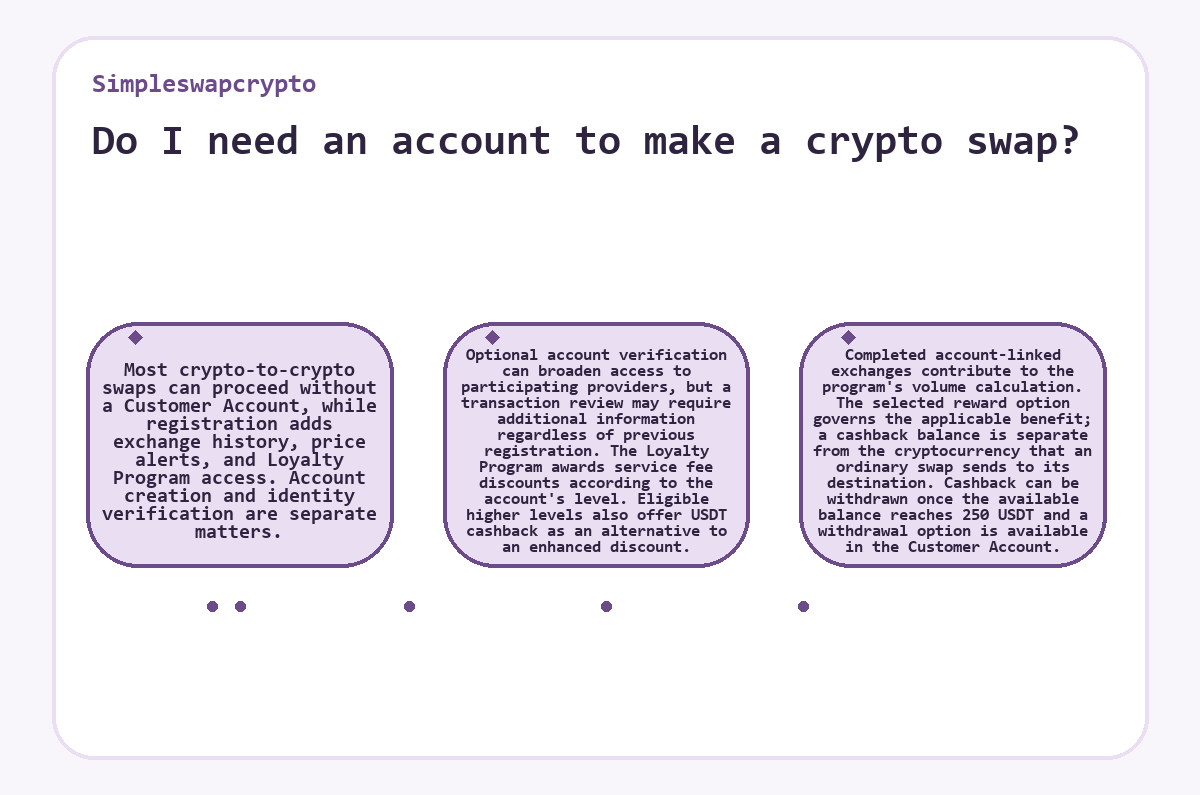
The Loyalty Program awards service fee discounts according to the account's level. Eligible higher levels also offer USDT cashback as an alternative to an enhanced discount. Completed account-linked exchanges contribute to the program's volume calculation. The selected reward option governs the applicable benefit; a cashback balance is separate from the cryptocurrency that an ordinary swap sends to its destination. Cashback can be withdrawn once the available balance reaches 250 USDT and a withdrawal option is available in the Customer Account.
Fiat purchases and supported crypto sales
Fiat services connect conventional payment methods with cryptocurrency, and their supported assets and payment options differ from the crypto swap catalog.
Purchases through payment providers
A fiat purchase uses a third-party payment provider available for the selected currency, asset, payment method, and region. Provider checkout can require identity or payment verification. The final offer can include payment processing costs, exchange spread, and network-related charges. A crypto asset available for swapping is not automatically available through every purchase provider. Provider terms and limits apply alongside the service's eligibility conditions.
Crypto sales with fiat proceeds
Supported crypto sales exchange digital assets for fiat through the available selling arrangements, including bank transfer where offered. The payout method belongs to that selling offer. A crypto-to-crypto swap instead delivers another digital asset to a wallet address. These destinations have different requirements, so a wallet-only exchange quote does not establish eligibility for a bank payout or any particular payment method.
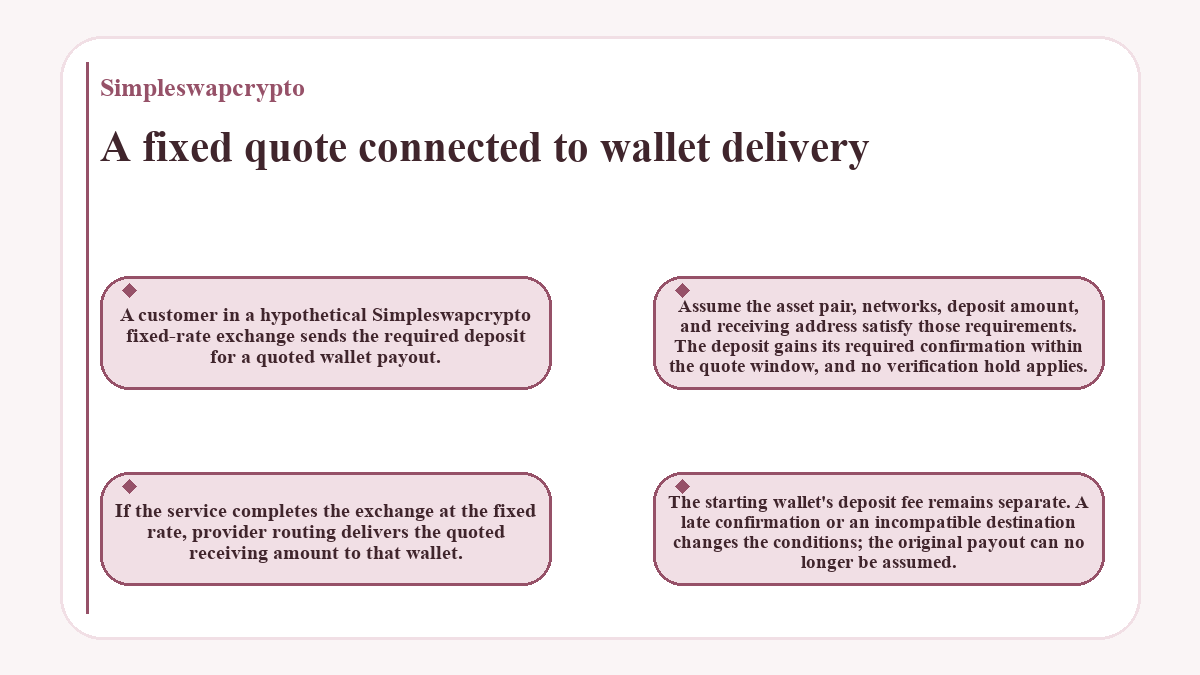
A fixed quote connected to wallet delivery
A customer in a hypothetical Simpleswapcrypto fixed-rate exchange sends the required deposit for a quoted wallet payout. Assume the asset pair, networks, deposit amount, and receiving address satisfy those requirements. The deposit gains its required confirmation within the quote window, and no verification hold applies. If the service completes the exchange at the fixed rate, provider routing delivers the quoted receiving amount to that wallet. The starting wallet's deposit fee remains separate. A late confirmation or an incompatible destination changes the conditions; the original payout can no longer be assumed.
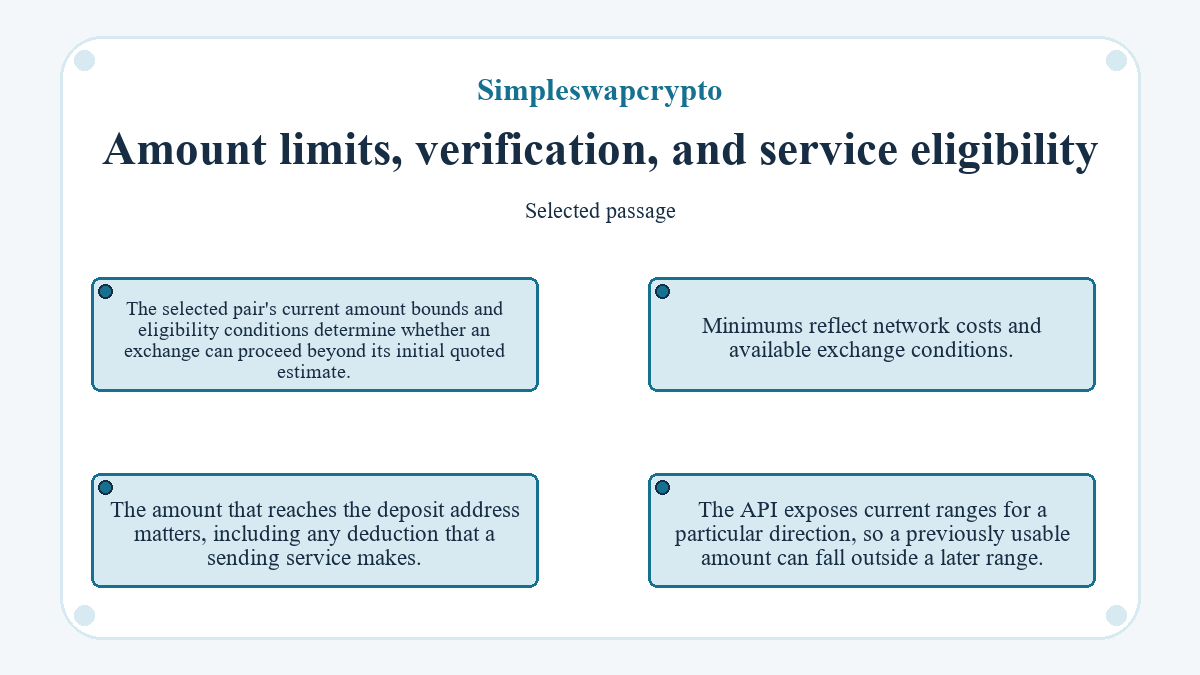
Amount limits, verification, and service eligibility
The selected pair's current amount bounds and eligibility conditions determine whether an exchange can proceed beyond its initial quoted estimate. Minimums reflect network costs and available exchange conditions. The amount that reaches the deposit address matters, including any deduction that a sending service makes. The API exposes current ranges for a particular direction, so a previously usable amount can fall outside a later range.
Floating swaps have no strict service-wide upper amount restriction, but liquidity and internal checks still constrain execution. Fixed-rate offers may impose limits for their selected pair. Absence of a universal maximum does not establish available liquidity for an arbitrary deposit. Sending below an order's minimum can prevent processing and can make a refund unavailable.
Transaction monitoring can trigger Know Your Customer verification, commonly abbreviated as KYC, or questions about deposit ownership and source of funds. Optional verification during account registration does not remove transaction-specific checks. Suspected unlawful activity or a legal order can cause a freeze. A review therefore changes the processing conditions, even when the recipient address and original quote were otherwise suitable.
Regional restrictions apply to the service itself as well as provider-dependent fiat offers. The Terms of Service effective September 7, 2026 list the United States and its territories, the United Kingdom, China, India, Japan, Germany, and France among restricted locations. Eligibility also requires an age of at least 18, or the higher age required to form a binding contract locally. The service excludes politically exposed persons, restricted persons, and their family members or close associates. Access through a browser, app, or integration does not override those conditions. The availability of an interface and permission to use the underlying service are separate questions.
Registration-free exchange still creates transaction and usage records. The service processes exchange amounts, destination addresses, and routing information, and collects usage information such as IP addresses and activity logs. Contact details or verification documents may enter those records when required for processing or support. Wallet control and privacy concern different parts of this arrangement; avoiding a stored trading balance does not make transaction records anonymous.
Partner integrations and exchange tracking
Partner tools include an application programming interface, or API, plus widgets, buttons, banners, and referral links. An API integration gives a product access to currency choices, estimates, exchange creation, and status information. API access uses partner credentials, and API partners must verify their accounts. Unverified API use is limited to 2 BTC or 100,000 USDT in exchange volume. Reaching the limit blocks new API exchanges without blocking the other partner tools. Referral and embedded tools offer different integration depths, and partner rewards follow their own settings and eligibility rules.
The API can base a request on the amount to send or the amount to receive. Those modes give the amount field different meanings. For fixed-rate creation, the integration must carry forward the identifier that accompanies its fixed estimate. A preliminary availability response checks the proposed parameters without creating an exchange. An exchange creation response provides an initial state, and later status information reports progress.
Blockchain confirmation, conversion, and payout represent different parts of processing. Network congestion, provider liquidity, and additional checks can extend the overall duration. The service's Finished status identifies completion of its exchange process. The receiving transaction record supplies the corresponding blockchain details. Keep that record alongside the order's Exchange ID.
Useful questions about Simpleswapcrypto
Can I abandon a swap before sending the deposit?
An unfunded exchange can be left unused without a cancellation request. You can create another order if the details need changing. Once a deposit has been sent, cancellation depends on the order's processing state; closing the browser does not reverse the transfer.
What happens if my payment card is declined?
A declined card payment needs attention from the selected payment provider. Card support varies by provider and region. Another payment option may be available in the purchase flow, and the provider's support can address the rejection.
Is the deposit transaction hash enough for a support request?
Support usually needs the Exchange ID as well as the deposit transaction hash once funds have been sent. The Exchange ID identifies the service order, while the transaction hash identifies its blockchain transfer. Neither identifier requires disclosing your wallet's private keys.
Will a refund request require proof of deposit ownership?
A refund request can require additional evidence that you own the deposit. Depending on the case, support may request transaction records, screenshots, or account statements. Establishing ownership does not by itself establish refund eligibility or remove applicable network or recovery costs.
Do browser extensions unlock additional loyalty rewards?
Browser extensions and scripts do not unlock hidden Loyalty Program benefits. Rewards depend on the account's program settings and eligible exchanges. Software that promises an extra bonus can alter wallet addresses or collect sensitive information; it is not part of the reward program.
Last updated: