 Simpleswapcrypto
Simpleswapcrypto refunds: Deposit returns, eligibility, and fees
Simpleswapcrypto refunds can return eligible deposits after an exchange fails or stops, subject to review and applicable fees. Some compliance-stopped swaps qualify for automatic returns. Sending a deposit does not create a universal right to cancel an exchange or receive the original amount in full.
Bottom line: A refund destination must accept the deposited asset and network, even when the original swap targeted a different cryptocurrency.
Deposit returns, revised rates, and refund status
Refunds return eligible deposits, while a revised-rate offer lets a stopped exchange continue under changed pricing. The Refunded status indicates a return; Failed indicates only that the exchange stopped. A request or failure message therefore does not establish that funds have reached your wallet.
Confirming, Exchanging, Sending, and successfully completed orders generally fall outside routine refund eligibility. The service can assess those requests case by case. Changes to an order may also become unavailable during processing. A refund transfer does not undo the original confirmed blockchain transaction.
Should I accept a new rate or request my deposit back?
A revised rate changes the exchange outcome, while a refund offer concerns returning the eligible deposit after any applicable charges. Compare the asset that each option returns, its destination network, and the associated costs. Continuing acquires the requested cryptocurrency; a deposit refund returns eligible starting funds.
A usable refund destination must exist before the return transfer. For a support-handled request, eligibility and any requested ownership checks also come before that transfer. An offer to review your case leaves the return undecided.
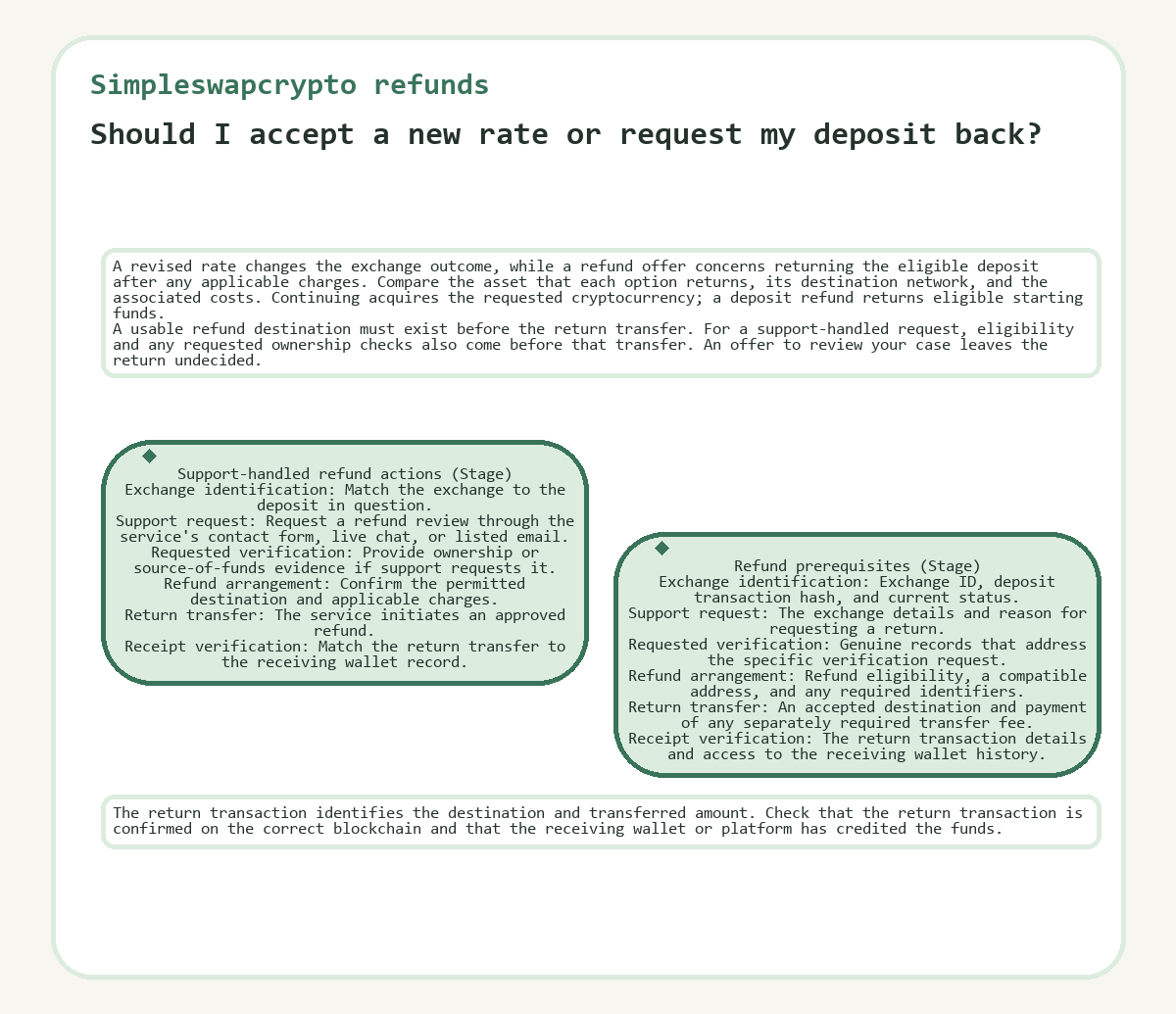
Should I accept a new rate or request my deposit back?
A revised rate changes the exchange outcome, while a refund offer concerns returning the eligible deposit after any applicable charges. Compare the asset that each option returns, its destination network, and the associated costs. Continuing acquires the requested cryptocurrency; a deposit refund returns eligible starting funds.
A usable refund destination must exist before the return transfer. For a support-handled request, eligibility and any requested ownership checks also come before that transfer. An offer to review your case leaves the return undecided.
- Support-handled refund actions (Stage) Exchange identification: Match the exchange to the deposit in question. Support request: Request a refund review through the service's contact form, live chat, or listed email. Requested verification: Provide ownership or source-of-funds evidence if support requests it. Refund arrangement: Confirm the permitted destination and applicable charges. Return transfer: The service initiates an approved refund. Receipt verification: Match the return transfer to the receiving wallet record.
- Refund prerequisites (Stage) Exchange identification: Exchange ID, deposit transaction hash, and current status. Support request: The exchange details and reason for requesting a return. Requested verification: Genuine records that address the specific verification request. Refund arrangement: Refund eligibility, a compatible address, and any required identifiers. Return transfer: An accepted destination and payment of any separately required transfer fee. Receipt verification: The return transaction details and access to the receiving wallet history.
The return transaction identifies the destination and transferred amount. Check that the return transaction is confirmed on the correct blockchain and that the receiving wallet or platform has credited the funds.
| Stage | Support-handled refund actions | Refund prerequisites |
|---|---|---|
| Exchange identification | Match the exchange to the deposit in question. | Exchange ID, deposit transaction hash, and current status. |
| Support request | Request a refund review through the service's contact form, live chat, or listed email. | The exchange details and reason for requesting a return. |
| Requested verification | Provide ownership or source-of-funds evidence if support requests it. | Genuine records that address the specific verification request. |
| Refund arrangement | Confirm the permitted destination and applicable charges. | Refund eligibility, a compatible address, and any required identifiers. |
| Return transfer | The service initiates an approved refund. | An accepted destination and payment of any separately required transfer fee. |
| Receipt verification | Match the return transfer to the receiving wallet record. | The return transaction details and access to the receiving wallet history. |
The return transaction identifies the destination and transferred amount. Check that the return transaction is confirmed on the correct blockchain and that the receiving wallet or platform has credited the funds.
Refund destinations and wallet compatibility
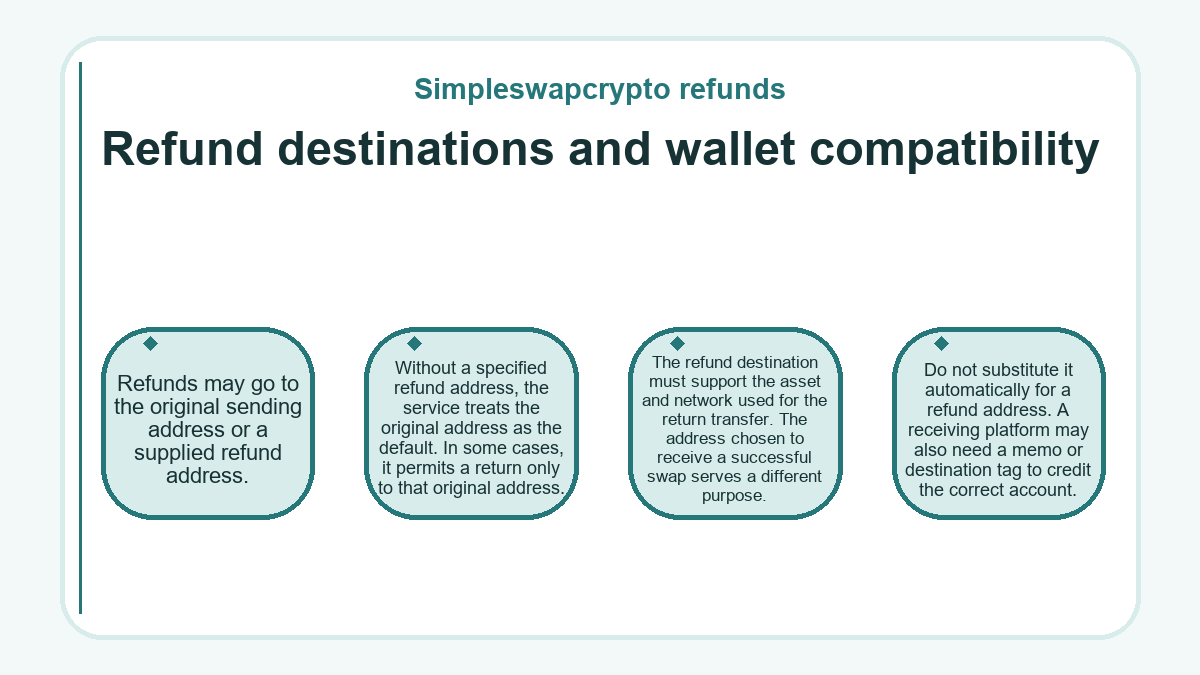
Refunds may go to the original sending address or a supplied refund address. Without a specified refund address, the service treats the original address as the default. In some cases, it permits a return only to that original address.
The refund destination must support the asset and network used for the return transfer. The address chosen to receive a successful swap serves a different purpose. Do not substitute it automatically for a refund address. A receiving platform may also need a memo or destination tag to credit the correct account.
Deposit errors and recovery limits
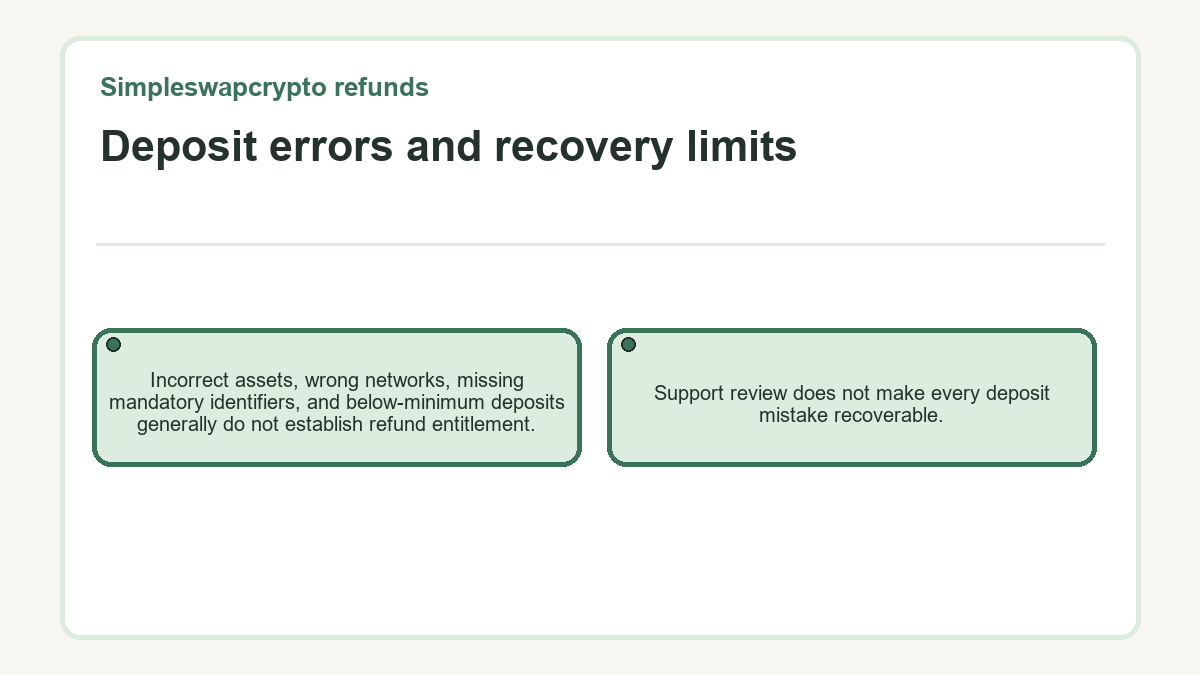
Incorrect assets, wrong networks, missing mandatory identifiers, and below-minimum deposits generally do not establish refund entitlement. Support review does not make every deposit mistake recoverable.
Asset and network mismatches
The exchange instructions specify the required deposit asset and network. A matching address alone does not establish that you used both correctly.
Missing identifiers and refund restrictions
Missing memo or destination tag
A mandatory memo or tag helps associate funds with the intended account. Omitting that identifier can leave a transfer uncredited, even when the address looks correct.
Deposit limits and excluded assets
The displayed minimum reflects the exchange conditions, including network costs. Sending less can prevent completion and make a refund unavailable. The service may offer a return for a mismatched deposit amount if the deposit exceeds the network fee.
Counterfeit assets, test-network assets, and assets involved in illicit activity fall outside the ordinary refund policy.
Late deposits and changed exchange rates
A late fixed-rate deposit may lead to a refund offer when the protected rate has changed. If the rate remains unchanged, the exchange can still proceed at that rate. Expiry alone therefore does not determine the outcome of a deposit that arrived.
A floating-rate exchange can also stop when the indicated receiving amount differs significantly from expectation. The service may offer a refund or seek approval to continue at the changed rate. Those options concern a paused exchange. Ordinary price movement after successful execution does not, by itself, establish refund eligibility.
Automatic returns after compliance screening
For eligible exchanges that cannot proceed after compliance screening, the service can return deposits automatically to the refund address without a support ticket. For partner swaps, the mechanism must be enabled and support the selected asset and network. This return path deducts the standard network fee and adds no service charge. A Verifying or Failed status alone does not establish eligibility for an automatic return.
Partner integrations need a refund address in the exchange request for the automatic return path. A partner may supply its own address and settle with the user separately. In that arrangement, a Refunded status at the exchange layer does not establish that your personal wallet received the funds. The partner still has to settle with you.
Eligible automatic returns usually take 5 to 15 minutes, with busy networks extending processing to as much as 30 minutes. That timing describes this return path and cannot establish a deadline for every recovery request.
Network charges and exceptional recovery fees
Network fees can reduce a deposit refund, and exceptional recovery work can involve an additional service-provider charge.
A token refund may require payment in the network's native coin to cover the return transfer fee. The refunded token and the coin that pays blockchain fees have different roles. Confirm any additional payment request through the support channel handling your exchange before sending funds.
Recovery fees can come out of the deposit or require a separate payment. Ask which deductions affect the returned asset and which require another transfer. Network costs vary with the asset, blockchain, and network conditions, so a fee estimate does not create a permanent refund charge.
Support checks without exposing wallet credentials
Support checks can involve deposit-ownership evidence beyond the Exchange ID and transaction hash, especially during refund or compliance review.
An Exchange ID identifies the swap; a transaction hash identifies a blockchain transfer. Avoid posting private exchange details publicly. Share the relevant records through the service's contact form, live chat, or listed support email.
Requested evidence can include screenshots, video confirmation, transaction records, and account statements. Keep the submission relevant to the ownership or source-of-funds check.
Support does not need your recovery phrase or private key to investigate a refund. A matching logo or knowledge of your exchange details does not authenticate an unsolicited message. Entering wallet credentials into a fake refund form can expose access to your remaining assets.
Request processing and unresolved returns
The refund policy effective 7 September 2026 allows up to 31 calendar days to process ordinary refund requests. Blockchain conditions separately affect the return transfer. That processing period does not establish approval or promise wallet delivery within the same interval.
Keep the request history, stated deductions, and refund transfer details until receipt or a final eligibility decision. A confirmation that support received your request establishes only receipt of the request. If additional verification remains outstanding or a legal restriction prevents release, the return remains unresolved.
Common questions, answered
Can I recover a second deposit sent to the same Simpleswapcrypto exchange address?
A repeated deposit requires support review, and a refund is not guaranteed. Deposit addresses belong to individual exchange orders. Sending additional funds to an old address does not create a new valid exchange automatically. Keep the additional deposit's transaction hash with the original Exchange ID so support can identify the transfer.
How should I handle a swap payout that a receiving platform rejected?
Contact support for remittance instructions before requesting a return from the receiving platform. Do not ask a third-party recipient that rejects or delays the swapped asset to return it to the address from which it arrived. This concerns the exchanged asset after payout and needs handling for that particular exchange.
Does a court-ordered freeze qualify for an automatic refund?
A court-ordered freeze continues until resolution or instructions from the relevant authority. Frozen-asset return requests follow a separate policy and require incident details, the source of funds, and documentation confirming identity and ownership. The terms effective 7 September 2026 set an administrative fee of 1% of the returned amount, with a $100 minimum. That charge applies to frozen-fund returns, not every ordinary deposit refund.
Is there a holding limit for unclaimed refund funds?
The terms effective 7 September 2026 limit the holding period to one calendar year and do not guarantee recovery afterward. Funds can become dormant sooner when identity or ownership documentation is insufficient. If you do not respond to a dormancy notice or contact attempts within 30 days, the service may charge administrative fees, close a dormant account, or remit unclaimed funds to authorities where required. Keep your contact details current and respond to outstanding ownership requests. A pending refund request should not be treated as an indefinite storage arrangement for the deposit.
Do card-purchase refunds follow the same rules as crypto deposit refunds?
Card-funded crypto purchases involve a separate payment provider whose conditions govern the transaction. Identify that provider and the purchase record before pursuing a payment refund. A crypto swap's status, refund offer, or automatic-return arrangements do not establish whether the payment provider will reverse a card purchase.
Last updated: